

如何用中文表达“昨天、今天、明天”和其他时间词 | Mandarin Classes NYC

How to Say Yesterday, Today, Tomorrow and Other Time Words in Chinese
在 Beautiful Mandarin NYC,每天晚上我们都有小组中文课,大家一起学中文。上个星期二,我一走进教室,就看到学生 Nell 已经在白板上写着什么。
At Beautiful Mandarin NYC, we have group Chinese classes every evening where students come together to learn and practice Mandarin. Last Tuesday when I walked into the classroom, I saw that our student Nell had already filled the whiteboard with notes.
原来她正在总结如何表达 yesterday、tomorrow、last week、next week 等等的时间词语。对很多中文学习者来说,这些表达方式确实常常会让人感到有些困惑。
She was actually summarizing how to express time in Chinese — words like yesterday, tomorrow, last week, and next week. These expressions can often be confusing for Chinese learners.
自从 Nell 注册了我们的 Unlimited Classes(无限上课)学习计划 以后,她的中文学习热情得到了很大的满足。她几乎每周都会来上 2–3 次课。
Since Nell signed up for our Unlimited Classes program, her enthusiasm for learning Chinese has really been satisfied. She now comes to class two to three times a week, giving herself many opportunities to review and practice what she has learned.
那天的课堂上,我们就和 Nell 一起复习了一下,如何用中文正确表达 过去、现在和未来 的时间。现在也邀请读者们和我们一起学习吧
That day, we reviewed together how to correctly express past, present, and future time in Chinese. Now we invite our readers to learn along with us.

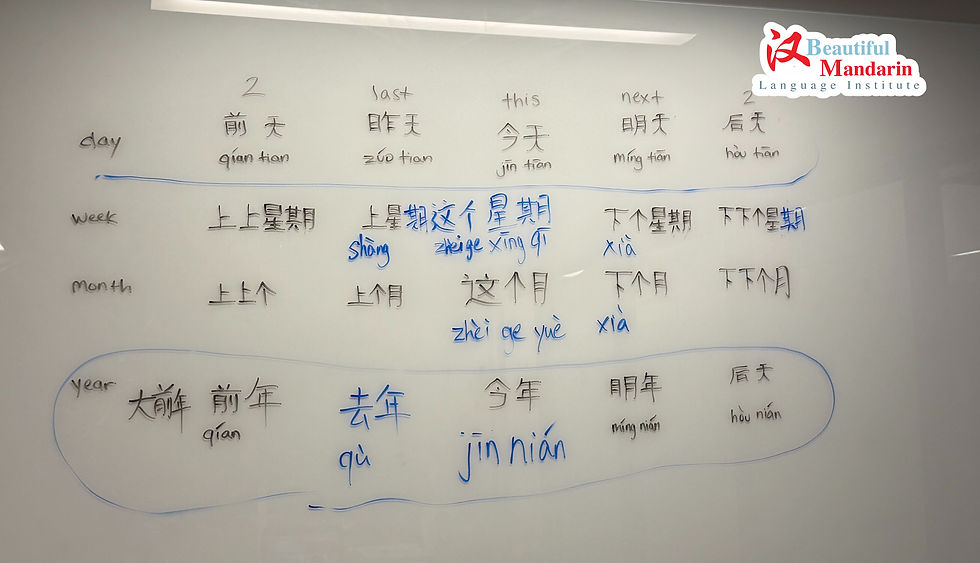
中文中如何表达“昨天、今天、明天”?
一、天 tiān(Day)
前天 (qián tiān) — the day before yesterday
昨天 (zuó tiān) — yesterday
今天 (jīn tiān) — today
明天 (míng tiān) — tomorrow
后天 (hòu tiān) — the day after tomorrow
二、星期 xīng qī(Week)
上上个星期 (shàng shàng gè xīng qī) — the week before last
上个星期 (shàng gè xīng qī) — last week
这个星期 (zhè gè xīng qī) — this week
下个星期 (xià gè xīng qī) — next week
下下个星期 (xià xià gè xīng qī) — the week after next
三、月 yuè(Month)
上上个月 (shàng shàng gè yuè) — the month before last
上个月 (shàng gè yuè) — last month
这个月 (zhè gè yuè) — this month
下个月 (xià gè yuè) — next month
下下个月 (xià xià gè yuè) — the month after next
四、年 nián(Year)
大前年 (dà qián nián) — three years ago
前年 (qián nián) — the year before last
去年 (qù nián) — last year
今年 (jīn nián) — this year
明年 (míng nián) — next year
后年 (hòu nián) — the year after next
中文时间表达的规律
通过这些例子可以看到,中文表达时间其实有很清晰的规律:
Through these examples, we can see that Chinese time expressions follow very clear patterns.
上(shàng) / 去(qù)/ 前(qián) → 表示过去 (past)
今(jīn),这(zhè) → 表示现在 (present)
下(xià) / 明(míng) / 后(hòu) → 表示未来 (future)
掌握这些规律之后,学习者就可以很自然地表达很多时间概念。
Once learners understand these patterns, they can naturally express many time concepts.
例句 Examples
我去年去了中国。
(wǒ qù nián qù le zhōng guó)
I went to China last year.
我们下个月见。
(wǒ men xià gè yuè jiàn)
See you next month.
他前天来了。
(tā qián tiān lái le)
He came the day before yesterday.
如果你也想在这样的环境中学习中文,欢迎来 Beautiful Mandarin NYC 的课堂体验一下。无论是刚开始学习中文,还是已经有一定基础的学习者,无论是见面还是网上,都可以在这里找到适合自己的 Mandarin classes,和来自不同背景的同学一起学习、交流和进步。
If you would also like to learn Chinese in an environment like this, you’re very welcome to experience a class at Beautiful Mandarin NYC. Whether you are just beginning to learn Chinese or already have some foundation, and whether you prefer in-person or online classes, you can find the Mandarin classes that suit you here, and learn, interact, and grow together with classmates from different backgrounds.




Comments